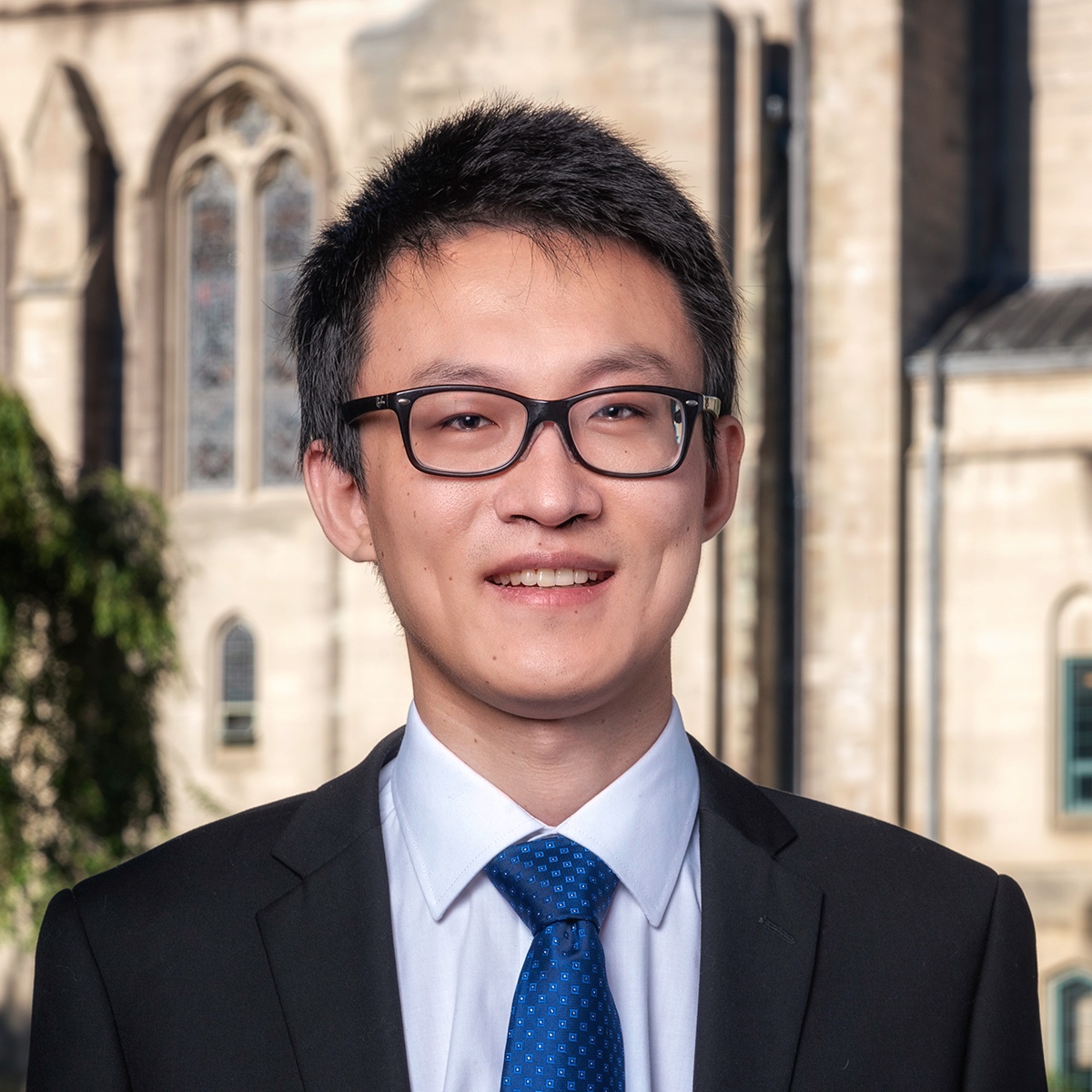
Jingye Wang

Jingye Wang

About

Position
Assistant Professor, School of Finance, Renmin University of China
Education
Ph.D. in Economics, Boston University, 2022
M.A., Graduate Program in Economic Development, Vanderbilt University, 2016
B.A. in Economics and B.A. in Information Management and Systems, Peking University, 2013
Fields
International finance, international macroeconomics, asset pricing

Publications

Trade War and the Dollar Anchor

With Tarek A. Hassan, Thomas M. Mertens, and Tony Zhang. Brookings Papers on Economic Activity, Fall 2025, 65-113.

We develop a general-equilibrium model in which the safety of a country's currency and the choice of its exchange-rate regime arise endogenously. A trade war that isolates U.S. goods markets from the world erodes the U.S. dollar's safety premium, raises U.S. interest rates, and lowers the world market value of U.S. firms. For sufficiently high tariffs, small economies optimally re-peg to the euro, producing a euro-centric international monetary system and a global welfare loss.

Working Papers

Openness, Integration, and the International Monetary Order

With Tarek A. Hassan, Thomas M. Mertens, and Tony Zhang. Paper presented at the 2nd Economic Policy: Papers on European and Global Issues Conference, 2026.

This paper develops a calibrated general-equilibrium model to study how trade and financial policy reshape the hierarchy of global currencies. Currency safety and anchor status arise from each economy's effective size: tariffs reduce this size on the goods side, while capital controls do the same on the financial side. The economy that maintains the deepest integration with global trade and financial markets retains the largest safety premium and gains anchor status.

A Currency Premium Puzzle

With Tarek A. Hassan and Thomas M. Mertens, 2024.

Canonical long-run risk and habit models reconcile high equity premia with smooth risk-free rates by inducing an inverse relationship between the variance and the mean of the stochastic discount factor. We show this mechanism is problematic in open economies with complete markets because it requires currency-return differences to arise almost exclusively from predictable appreciations, while the data show that exchange rates are largely unpredictable and currency returns differ because interest rates differ across currencies.

Currency Risk and Capital Accumulation

Working paper, 2021.

This paper studies how currency risk affects capital accumulation across countries. In a quantitative multi-country model with external habit and heterogeneous exposure to a global productivity shock, currency risk generates cross-country variation in risk-free rates and capital-output ratios. Estimated exposures from GDP data are strongly correlated with capital-output ratios, and the model accounts for roughly 55 percent of the cross-country variation in the data.

Teaching

  • Lectures on China's Financial MarketsFall 2023-2025
  • Model IMFSpring 2024-2026
  • Finance (A)Spring 2024-2026
  • Mathematical Methods in EconomicsSpring 2024

Contact

School of Finance
Renmin University of China
59 Zhongguancun Street
Beijing 100872, China

wang.jingye@hotmail.com
jingyewang@ruc.edu.cn